
How and When to Discount: A Strategic Guide for eCommerce Brands
Introduction:
The annual BFCM and Q4 frenzy are closely associated with significant discounts. For DTC brands, this period presents a monumental yet fleeting opportunity to capitalise on the year’s peak shopping moment. As per an Adobe report, the Electronics category experienced a notable peak discount of 25% during BFCM 2022, a substantial rise from 8% in 2021. Prominent discounts were observed across all categories. Given the emphasis on discounting, brands must strategise to ensure they offer discounts that align with their profitability objectives. Key considerations include the timing of promotions, the nature of discounts, and whether to offer site-wide discounts or tailored ones for specific segments.
The Shift in Shopping Trends:
As door-buster deals wane, it’s anticipated that online sales will commence ahead of and prolong past the BFCM weekend. According to a 2021 holiday trend report by Justuno, 65% of US shoppers expressed their intent to finalise holiday purchases before Thanksgiving. Notably, November 2021 witnessed a 10% surge in sales compared to the previous year, while Black Friday sales plummeted by 31%. Considering the trend of early shoppers and their deliberation between online and local purchases, it’s crucial to relay your offers as soon as feasible. Moreover, if it aligns financially and operationally, consider extending these offers post-BFCM.
Analysing Discount Impact on Profitability:
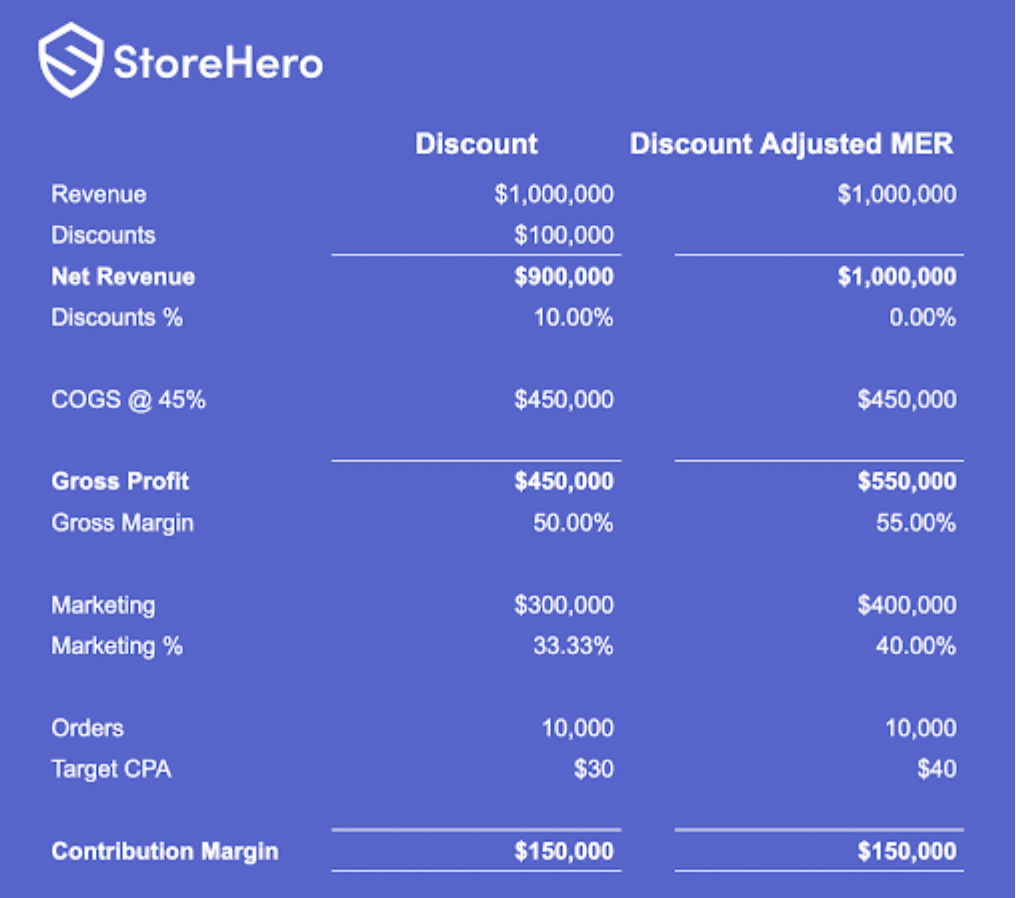
To accurately assess the effect of discounts on profitability, it’s crucial to understand how these discounts impact margins, particularly in terms of Cost Per Acquisition (CPA). If a product is priced at $100 with a CPA of $33, how does the CPA adjust when introducing a 10% discount? Below are two distinct scenarios to elucidate the differences.
- Example One: Traditional Discounting
-
- Forecasted Sales and Net Revenue: The business anticipates sales of $1,000,000, applying a 10% discount. This equates to a net revenue of $900,000.
- Cost and Gross Profit: The Cost of Goods Sold (COGS) to achieve this revenue is $450,000, resulting in a gross profit of $450,000 and a gross margin of 50%.
- Average Order Value and Anticipated Orders: Post-tax, the average order value is projected at $100, translating to an expected 10,000 orders.
- Marketing Efficiency Ratio (MER) and CPA: With an MER of 3, the business plans to spend $300,000 to achieve $900,000 of net revenue. This necessitates a CPA of $30 for each of the 10,000 orders.
- Example Two: Treating Discount as Marketing Cost
- Sales and Net Revenue: The company realizes sales of $1,000,000. Instead of providing a discount, this amount is incorporated into the marketing expenses.
- Cost and Gross Profit: The COGS remains at $450,000, generating a gross profit of $550,000 and a corresponding gross margin of 55%.
- Adjustment to Ad Costs and Number of Orders: Initially, the company allocates $300,000 for ads. However, the foregone discount amount is reintroduced to the marketing expenditure, totaling $300,000 + $100,000 = $400,000. Given that the number of orders remains constant at 10,000, the effective CPA is recalculated.
- Revised CPA: By including the discount in the marketing expenses, the new CPA rises to $40 per order.
Primary Discount Methods for eCommerce Brands:
- Percentage discounts- This is a discount that takes a percentage off the total price of a product or order. For example, a 20% discount on a €100 order would reduce the
- price to $80.
- Fixed amount discounts- This is a discount that subtracts a fixed amount from the total price of a product or order. For example, a €10 discount on a €100 order would reduce the price to $90.
- Free shipping- This is a discount that offers free shipping on a product or order. It can be a powerful motivator for customers who are reluctant to pay shipping fees.
- Buy-one-get-one (BOGO)- This is a discount that offers a free product when a customer purchases a specific product. For example, a BOGO deal might offer a free t-shirt when a customer buys a pair of jeans.
The Strategy Behind Discounts:
Discounting is a powerful tool for eCommerce brands to attract customers, generate sales, and increase revenue. However, using discounts effectively requires a strategic approach, constant evaluation, and careful consideration of the long-term impact on the bottom line.
Discounts have the potential to be beneficial, but in order to make sure they are accomplishing their objectives, they must be regularly reviewed. It’s crucial to remember that discounts, particularly when applied carelessly, can seriously harm a company’s bottom line. Furthermore, those who are not driven or encouraged by the bottom line frequently use discounts.
It is more crucial than ever to take the financial impact of discounts into account in an era of increasing advertising expenses and narrowing margins. While discounts can result in short-term profits, they can also have long-term negative effects like reduced margins and a lowered value for the brand.
Trading discount dollars for ad spend is one method to use discounts more strategically. This can lead to a more effective marketing efficiency ratio (MER) or customer acquisition cost (CAC).
Nevertheless, when employing this strategy, bear the following two points in mind:
- Pay attention to how the customer’s lifetime value (LTV) is affected by the discount they receive. Discounts may draw clients who are only interested in the deal and may not turn into devoted, recurring clients.
- Verify that acquisition discounts or offers do not affect current customers’ orders. Ignoring the needs of returning customers can quickly hurt a business’s profitability because they generate more revenue.
In a world of rising ad costs and thinner margins, it’s more important than ever to consider the impact of discounts on the bottom line. Discounts may lead to short-term gains, but they can also lead to long-term problems such as reduced margins and lower perceived brand value. By carefully considering the impact of discounts on customer lifetime value and retention, brands can use discounts as a powerful tool to drive sales and increase revenue.
2 Responses